
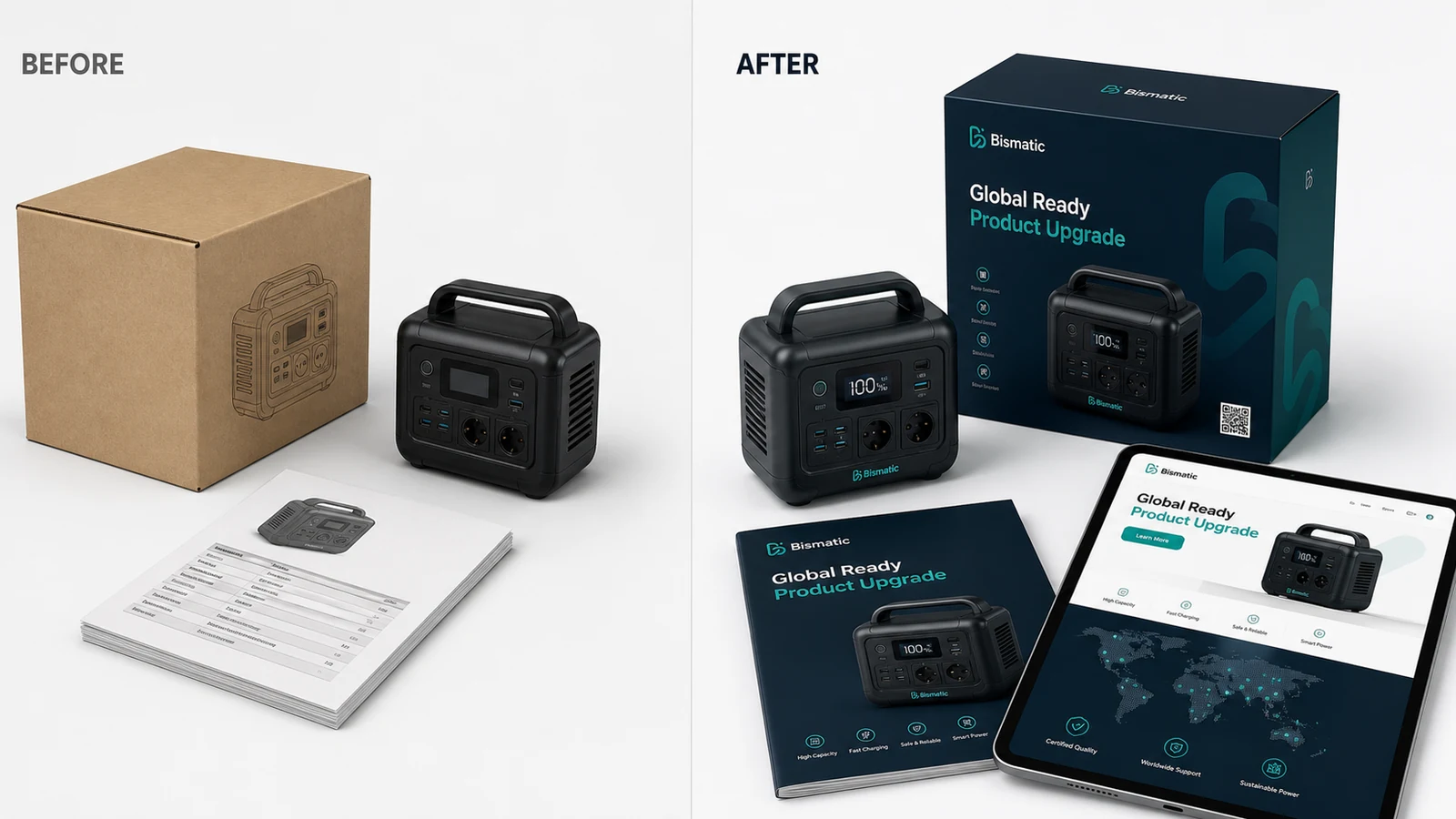
In manufacturing regions such as Yiwu, Taizhou and Wenzhou, many export companies have mature production lines, reliable supply chains and years of process knowledge. They can produce dependable goods at competitive cost for buyers around the world. Yet many of these companies face the same problem: the product is good, delivery is stable, but the business still has to win orders through low pricing.
The weakness is often not production. It is how value is presented. If an exporter relies only on cost, capacity and samples, it is easily grouped with similar suppliers. To move from OEM work and price competition toward a stronger international brand, a company must turn manufacturing strength into visible trust. That means treating brand identity, packaging, product appearance, website content, photography, sales documents and exhibition material as one buyer-facing system.
The real problem is often that value cannot be seen
Many traditional exporters already have serious operational capability. They control quality, meet delivery schedules, integrate suppliers and sometimes produce for well-known international brands. Still, when they approach overseas buyers, distributors or brand owners, they lose good opportunities to competitors with clearer presentation.
The reason is simple: overseas buyers cannot verify everything at the first contact. Distance, culture and information gaps make early trust difficult. Before a buyer speaks deeply with sales, they have often reviewed the website, images, packaging, catalogues, quotations and overall visual style.
If those materials look inconsistent, outdated or hard to understand, the company may be judged as small, unstable or poorly managed. This is a common problem for capable export factories: real manufacturing value is hidden behind weak presentation, so the market does not give the company full credit for what it can actually do.
Why professional buyers care about presentation systems
Some manufacturers still believe buyers only care about price, quality and lead time. Those factors matter, but professional B2B buyers also use presentation as a visible signal of management quality and cooperation risk.
Consistent visual identity suggests standardised control. Clear product hierarchy makes specifications and applications easier to verify. Strong photography reduces uncertainty about materials, finish and structure. A complete, credible website supports the impression that the company is organised, traceable and ready for long-term cooperation.
Presentation cannot replace certification, engineering skill, delivery performance or after-sales service. It carries those strengths. A good presentation system helps buyers understand the real capability faster and gives them a reason to continue the conversation beyond price.
Serious brand upgrading starts with positioning
Many companies begin an upgrade with a logo, a packaging mock-up or a homepage design. They ask for something more premium or more international. That approach often misses the business problem. Export brand upgrading should start with market positioning, then move into visual execution.
Before design begins, the company should define the target buyer: wholesaler, brand owner, retailer, distributor or cross-border seller. It should clarify the price level, sales channels, competitor set and proof points that can be verified. Only then can the design team decide what should feel refined, what should feel technical, what must be direct, and where the brand can be visibly different.
A good result is not merely attractive. It helps sales explain the offer, helps buyers understand product value, and creates assets that can be reused across websites, packaging, quotations, exhibitions and social channels.
Buyers are looking for five kinds of evidence
B2B purchasing is usually rational. Buyers want to reduce risk, compare suppliers efficiently and avoid problems after the order. In practice, they are looking for five types of evidence.
The first is category understanding. Product appearance, application images and use scenarios should show that the company understands the market, not just low-cost production. The second is technical reliability. Structure diagrams, specification tables, material notes and process explanations need to be clear and organised. The third is production stability. Consistent packaging, company profiles and case examples suggest repeatable operations.
The fourth is communication clarity. A well-structured website, catalogue and quotation system helps buyers evaluate the offer internally. The fifth is after-sales confidence. Service procedures, quality checks, delivery information and case references reduce uncertainty.
Packaging, product styling, website content and sales materials should all support these forms of evidence. They are not isolated design tasks. They are tools for lowering the buyer's decision cost.
Common mistakes that weaken trust
The first mistake is fragmented execution. The logo has one style, packaging has another, photography follows no standard, the website repeats generic claims, and exhibition posters look unrelated to the sales deck. When touchpoints do not match, buyers may assume the company lacks control over details.
The second mistake is chasing a premium look without category logic. Some manufacturers copy the minimal style of global brands without considering product type, price point or customer expectations. Industrial parts can become too decorative. Low-price daily goods can look unrealistically expensive. Professional buyers quickly notice when design does not match the product's real position.
The third mistake is replacing useful information with slogans. Pages may say reliable factory, quality assured or direct manufacturer, but omit the information buyers need: specifications, compatible scenarios, differences from alternatives, lead time, inspection standards, after-sales policy and case references. For a professional buyer, design without practical information has little commercial value.
Bismatic's approach: build the system around business results
Bismatic does not treat brand upgrading as a single logo, packaging or website task. We see brand identity, product appearance, industrial styling, website content and sales material as one commercial system. The work is built around four goals: increase trust, reduce communication cost, support sales progress and improve pricing power.
The process usually starts with an audit of current assets: website pages, packaging, product images, catalogues, quotations, sales documents and product appearance. We identify where trust is lost and where value is not explained clearly. Then we define market position and differentiation based on product category, target markets, buyer types and competitors.
The final output is a practical visual asset system that can be used across brand identity, packaging, product presentation, websites, sales documents and exhibition material. The purpose is not cosmetic change. The purpose is to make manufacturing capability visible, understandable and easier for buyers to trust.
Visual presentation is now a core export capability
For traditional export manufacturers, brand visuals, packaging, product appearance and website presentation are not decorative extras. They are business tools for entering higher-quality markets, reducing price pressure and improving negotiation power.
When products, packaging, websites, sales documents and exhibitions tell the same clear story, buyers understand value faster. In categories where many suppliers can produce similar goods, the ability to communicate value clearly can be the difference between being treated as a commodity supplier and being considered a serious long-term partner.
Professional upgrading needs measurable standards
Brand upgrading should not depend only on personal taste. A practical evaluation system should ask six questions. Can a buyer understand the product advantage within a few seconds? Are specifications, use cases, services and differences easy to find? Are all touchpoints visually and logically consistent? Are technical and compliance details easy to verify? Can the sales team reuse the assets directly? Can the design be produced, printed, displayed online and used at exhibitions without unrealistic assumptions?
If a design only works in one beautiful mock-up but cannot extend to packaging, catalogues, websites and sales documents, it is not a system. If the look becomes more refined but the buyer's key information is hidden, it is not a successful commercial upgrade.
A final checklist before launch
Before launching a new brand and visual system, an exporter should check six points. Can a buyer unfamiliar with the company understand the core product value in three to five seconds? Do all product images follow the same photography, lighting and background standards? Does the packaging remain clear when viewed from a distance, during transport and in retail or exhibition settings? Does the website answer questions about qualifications, capacity, specifications, applications, delivery, service and cases? Can the sales team use the same assets for quotations, follow-ups, exhibitions and brand promotion? Can every design be produced, printed and displayed without false or impractical details?
Only when these checks are passed does visual upgrading become a reusable business asset. The path from Yiwu product to global brand is not about louder claims. It is about making real capability clearer, more specific and more trustworthy to buyers around the world.