
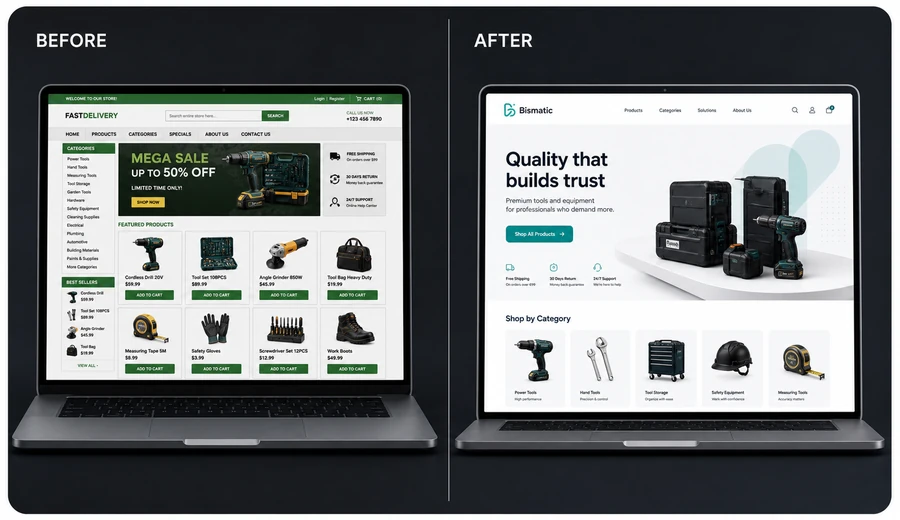
For many traditional manufacturers, local factories and long-established trading companies, the problem is not weak products. The problem is that real capability does not translate into digital trust. Automated lines, supplier networks, quality control, OEM experience and completed projects often remain inside workshops, production records and offline contracts. Overseas buyers cannot see them quickly online.
This creates a painful gap: strong factory capability, weak digital credibility. In today's cross-border B2B process, a strength the buyer cannot see may as well not exist. An outdated website, generic claims, unclear product data and inconsistent visuals can make a strong factory look small, unstable or inexperienced in international cooperation.
Modern buyers often verify online first, speak offline second and test orders later. A website is no longer a digital business card. It is a primary source for supplier screening, risk evaluation and early decision-making.
Why buyers include websites in risk evaluation
Consumer users may judge a website by mood, novelty and beauty. B2B buyers, engineers, brand buyers and overseas distributors look for three things: controllable risk, credible information and stable cooperation.
A consistent visual system suggests standardised operation. Layout, colour, product photography and written style should follow the same rules. This gives the impression that details are managed.
Clear information architecture makes technical verification easier. If specifications, applications, cases, certifications and delivery processes are easy to find, buyers need fewer rounds of clarification.
Standardised product materials reduce uncertainty. Consistent photos, detail images and process explanations help buyers understand product condition, specification and batch stability.
Complete website content shows international operating maturity. Multilingual pages, certification proof, service process and after-sales information show that the company is not simply testing export sales, but preparing for long-term cooperation.
Digital presentation cannot replace certification, engineering, delivery capacity or service. It carries these strengths online. A professional and credible website helps buyers recognise real manufacturing advantages and continue the conversation.
Commercial positioning before visual redesign
Many website redesign projects only make pages prettier or replace a template. That turns the website into a design refresh, not a business system. A B2B website should reduce buyer decision cost, explain differentiation and support qualified enquiries.
The first step is buyer definition. Project procurement, overseas retail channels, ODM brand buyers and smaller cross-border wholesalers care about different things. The website must know who it is speaking to.
The second step is market and channel positioning. A company pursuing technical premium, stable mid-market value or large-volume supply needs a different tone, proof structure and content focus.
The third step is competitor analysis. If competing websites lack detail, show poor visuals or fail to explain process advantages, those gaps become opportunities. Capacity, process, technology, service and cases should be organised into buyer-readable evidence.
The fourth step is modular upgrading. Technical pages should be precise and transparent. Brand pages should be professional and orderly. Product pages should make functions and advantages easy to understand. Case pages should be real, specific and scenario-based.
A successful website upgrade lets buyers understand, lets sales explain and lets teams reuse assets across channels.
Five trust signals a website must carry
B2B online screening is a process of collecting trust evidence and removing cooperation risk. The website is the only digital place that can connect products, process, capacity, service, cases and qualifications in one system.
First, category depth. A website should not merely show product pictures. It should explain applications, working conditions, buyer pain points and solutions, proving that the company understands its segment.
Second, technical and quality reliability. Specifications, process standards, testing, patents and certifications should be clear and verifiable. The easier it is to check real information, the more credible the company becomes.
Third, production stability. Workshop images, production lines, capacity data, quality control flow and consistent product visuals help buyers judge whether the factory can deliver at scale.
Fourth, international communication efficiency. Multilingual content must read naturally for target buyers. Poor translation, direct Chinese logic and cluttered information increase communication cost.
Fifth, fulfilment and after-sales confidence. Delivery process, warranty policy, service structure and project cases reduce uncertainty in cross-border cooperation.
Four website mistakes that lose orders
The first mistake is fragmented brand touchpoints. Logo, product photos, packaging, website pages, exhibition material and quotation files all look unrelated. Buyers read this as weak management and low consistency.
The second mistake is pursuing a premium look without category logic. Industrial manufacturing, hardware parts and engineering equipment should feel stable, professional and reliable. Decorative lifestyle styles often create distrust.
The third mistake is replacing substance with claims. Phrases such as reliable factory, source manufacturer and quality assured mean little without specifications, process advantages, application scenarios, lead time, inspection standards, service policy and real cases.
The fourth mistake is generic template building. When many suppliers use similar layouts, copy and imagery, buyers cannot identify the real difference and the conversation returns to price.
Bismatic's website upgrade system
Bismatic does not treat website redesign as page decoration. We build a digital trust system for traditional manufacturers, turning the website from a static profile into a business asset for attracting enquiries, building trust and supporting sales.
First, we diagnose digital assets: missing information, visual inconsistency, empty content, translation problems and weak trust signals. We map where confidence is lost during the buyer decision journey.
Second, we rebuild commercial positioning based on product category, target markets, buyer groups and competitors. This defines the content structure and visual tone.
Third, we upgrade content and visuals systematically. We unify brand visuals, product photography standards, information hierarchy and multilingual rules, while adding specifications, scenarios, cases, certifications, delivery and after-sales content.
Fourth, we adapt assets for all channels. The website system should support packaging, brochures, exhibitions, quotation documents and social content so that the brand story stays consistent.
The goal is not simply a better-looking website. The goal is to make hidden factory strength visible, verifiable and credible online, shortening the buyer decision cycle and improving enquiry quality.
Evaluation standards for a professional website
A manufacturer website should not be judged only by taste. A useful website should let buyers identify positioning and product advantage within seconds. It should make technical data, applications, cases, certifications and delivery information easy to find. It should stay consistent with product, packaging and offline materials. Technical content should be readable for overseas engineers. Sales and marketing teams should be able to reuse the assets. Multilingual content should avoid obvious translation errors and cultural mismatch.
If a website looks refined in one page but cannot support sales, packaging, exhibitions and quotations, it is not a system. If the visual design improves but buyer-critical information is hidden, it will not improve conversion.
Final checklist before launch
Before launch, ask six questions. Can an overseas buyer understand the company position, core product value and differentiation in three to five seconds? Are product images, real photos and layouts consistent? Does the content answer questions about capacity, certifications, process, applications, delivery, service and cases? Is multilingual content accurate and natural? Can sales reuse website assets for quotations, follow-up, exhibitions and promotion? Do the website, products, packaging and offline materials tell one consistent brand story?
Only after these checks does website redesign become a business asset rather than a visual refresh. For traditional manufacturers going global, the task is not to make pages louder. It is to make offline manufacturing strength credible, searchable and usable online.